‘They destroyed me’: alcohol delivery services fuelling relapse, say people in recovery
New research finds rapid-delivery apps and targeted marketing are deepening isolation for people with alcohol dependence, with charities urging Government to act
People in recovery from alcohol dependence say rapid alcohol delivery services, run by some of the UK’s biggest supermarkets and technology platforms, are fuelling relapse, deepening isolation and putting lives at risk, according to a new report published today by the Institute of Alcohol Studies (IAS) and WithYou.
Enabling our isolation, by Dr Eric Carlin and funded by IAS, is based on five focus groups with 25 people in recovery in the North East of England. Participants described ordering spirits within minutes while too unwell to leave the house.
The report has been described as a wake-up call by Balance the North-East Alcohol Programme and Anissa Khalfa from Tyneside, who lost her cousin Tom to alcohol addiction fuelled by rapid deliveries.
One participant said:
“It destroyed me. Being able to get it, these services destroyed me, and that is God’s own truth… I could be mortgage free in 8 years and now I’m selling my house. It’s too easy. You wake up at two in the morning and, ‘I want a drink’, and then you can get access to it, within 15 minutes, half an hour.”
Bombarded by promotion
Every group described being bombarded with alcohol promotion on their phones, often while shopping for something else. Participants believed the marketing was personalised and algorithm-driven.
“I’ve got some bread and eggs and it’ll show you cans and a bottle… And it doesn’t show you food. The main drive of it is the alcohol.”
“Especially if you bought it previously, it comes up, ‘Oh, you want it again?’ You just click on it – and they know what I want.”
One participant described a multibuy wine offer as “a huge trigger” in early recovery.
Speed that harms
Speed was the biggest draw for people at their most unwell, and participants said a delay would have made a difference.
“I wasn’t capable of thinking past the next five minutes. If you said, ‘I’ll drop you three bottles of vodka in two days’, I’d have thought, ‘Oh, I’ll see you later’.”
Participants also contrasted apps with shops and pubs, where staff can refuse service:
“On the app, I can order there 24 hours a day and I’m never challenged about my mental fitness, how much I’ve drunk and that sort of thing.”
Another described crawling to the door:
“I crawled to my front door… kneeling on the floor. And he still handed over the package, the brown bag.”
Under the Licensing Act 2003, the offence of selling to a drunk person applies to licensed premises, and delivery drivers have no legal duty to refuse an intoxicated customer.
‘Never’ asked for ID
Participants described patchy age checks. One said:
“I used to be getting them to leave alcohol at 7 o’clock in the morning and they never once asked for a date of birth, and no one’s asked to see ID. Never.”
“My son’s 12 and he could order alcohol and the only reason he wouldn’t get it is because when he gets to the door, they’d realise that he wasn’t old enough.”
Enabling isolation
Participants said the services made isolation, a central driver of relapse, easier to sustain.
“I’m just laying in bed, and I can’t get up… someone turns up, go back upstairs in 30 seconds, it’s so easy. No other people.”
One group summed it up as “Enablement. Enabling our isolation.” Another participant said: “It’s facilitating your killing yourself.”
Most participants favoured a total ban on these services. The report calls on policymakers to:
- restrict rapid deliveries, for example through a minimum delay between order and delivery
- improve age verification and make clear who is accountable, without putting delivery drivers at risk
- ban the promotion of rapid deliveries and prevent targeted marketing of these services
- limit how much alcohol can be delivered to a household in a set period
- ban deliveries outside licensing hours
- let people exclude themselves from these services
- require public health messaging and signposting to support in every delivery
Dr Katherine Severi, Chief Executive of the Institute of Alcohol Studies, said:
“These services are built to be fast, frictionless and always on, and for someone fighting dependence that is a trap. The people in this report told us they were left alone, behind a closed door, with the drink delivered to them. The Government has said it is looking at this. The sooner the better, because people are dying now, and in some of the loneliest ways imaginable.”
Louise Stewart, Regional Director at WithYou, said:
“What people tell us in our services matches what’s in this report. Alcohol is now a few taps away, at any hour. People with living experience have been generous in sharing this, and they must be part of shaping the solution.
“This isn’t about placing blame; it’s about working together – health services, charities, policymakers, and delivery companies – to create a safer environment that reduces harm, reaches people earlier, and ensures anyone who needs help can easily access it.”
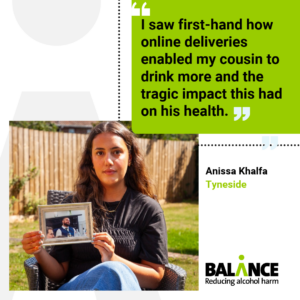
Anissa Khalfa, 18, from Tyneside has been campaigning for urgent action to tackle rapid online alcohol deliveries after her cousin Tom died following years of alcohol addiction and mental health challenges.
Tom was just 33 when he died in March 2025 – he had been able to order large quantities of alcohol through rapid delivery apps – which worsened the alcohol addiction, leading directly to his death.
Anissa said: “Like many of the people highlighted in this report, my cousin Tom was constantly exposed to pressures to drink. I saw first-hand how online deliveries enabled my cousin to drink more and the tragic impact this had on his health.
Tom was able to buy large amounts of alcohol at different times of day and night, without any refusal for being intoxicated. We don’t want others to go through what we experienced – but unless action is taken to regulate online deliveries, thousands of people will remain at risk.”
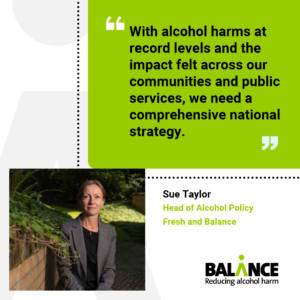
Susan Taylor, Head of Alcohol Policy for Fresh and Balance, said: “There are so many stories across the North-East and beyond, highlighting how rapid deliveries have destroyed people’s health, worsened alcohol addiction and added to pressures faced by the NHS.
“Delivery apps completely bypass the controls of the current licensing system, with vulnerable people able to access alcohol without the necessary safeguards to protect them. This is one area that clearly needs addressing.
“However, alcohol harms are not confined to people with addictions. Alcohol results in over 1 million hospital admissions a year in England across a range of illnesses including cardiovascular disease, seven types of cancer and liver disease.
“We need rapid action on alcohol delivery apps to stop more people becoming addicted to alcohol and suffering harm, but this must be part of a much wider approach. With alcohol harms at record levels and the impact felt across our communities and public services, we need a comprehensive national strategy, which raises awareness of alcohol harms and includes action on price, promotion and availability.”